
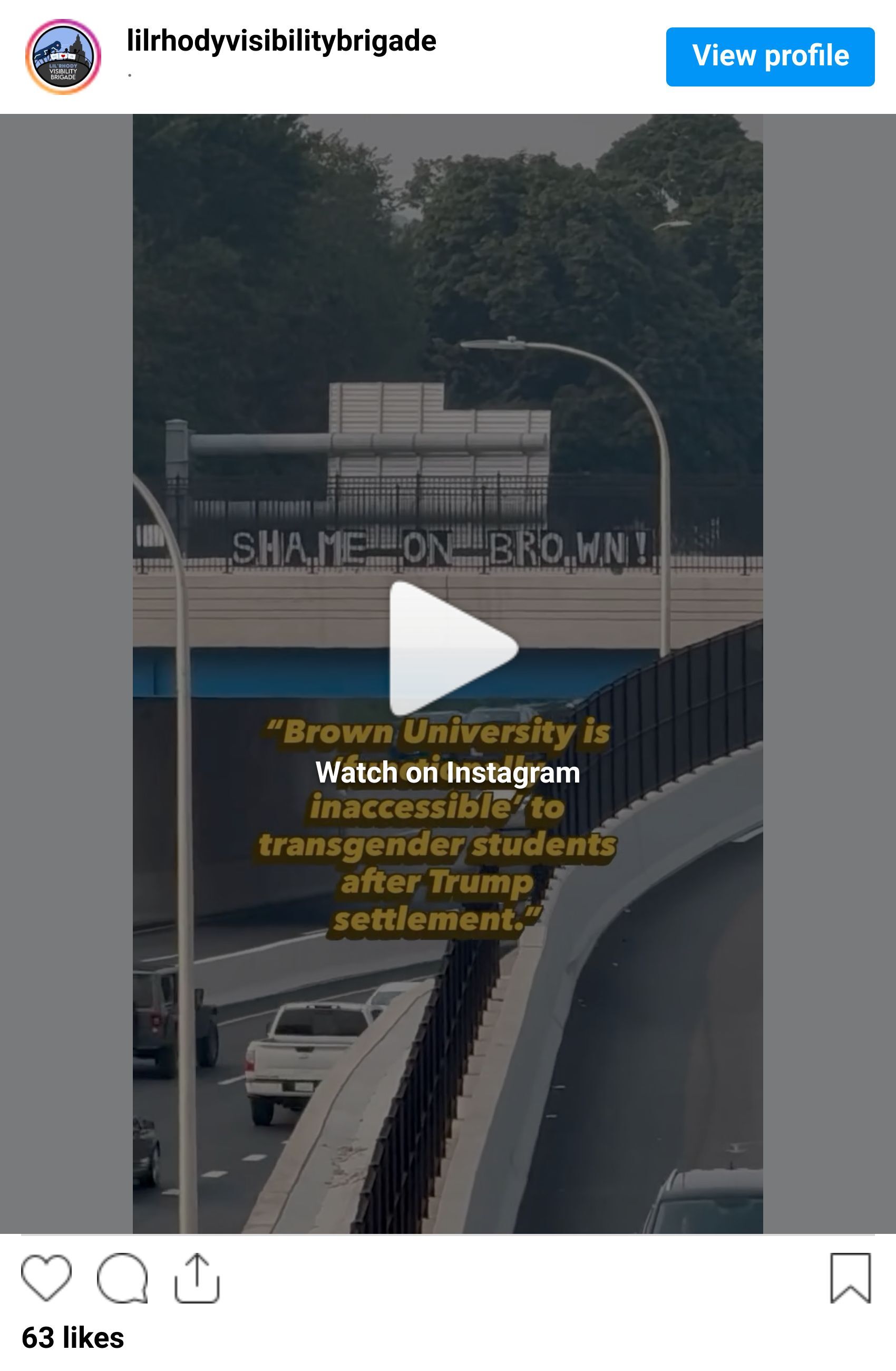
‘Shame on Brown!’ Lil’ Rhody Visibility Brigade protest. Screenshot of video courtesy of Ash.
Like our independent journalism? Help us keep doing it. Sign up for free updates with your email (we don’t send ads!), share this article with a friend, and support our fundraiser with a tax deductible donation.
When Ashe Shirazi moved from her conservative hometown in Florida to attend Brown University in Providence, R.I. she was expecting her life to become easier and safer.
“It was just so hard for me to exist within the administrative system,” she said. “I was at a very conservative school that wouldn’t allow me to transition or express myself … I wanted a school where my transition would be supported and protected.”
But now, in the second year of her four-year biochemistry degree, Shirazi feels neither supported nor protected by her university. “I’m always focusing on what rights I’m gonna lose today,” she told Trans News Network.
Shirazi’s feelings towards Brown University come as no surprise after its president, Christina Paxson, announced on July 30 that Brown, an historically very queer institution, had reached a voluntary agreement with the government to restore at least $50 million in federal research funding to the university.
For Paxson, this agreement is the crown jewel of Brown’s balancing act to keep the administration happy. In the announcement, which was sent in an email to the Brown community, she asserted there has been “a growing push for government into the fundamental academic operations of colleges and universities,” but that “Brown should uphold its ethical and legal obligations while also steadfastly defending academic freedom and freedom of expression.”
However, for the trans community at Brown, the agreement sends a clear message.
“They need this money,” Shirazi said, “and they need to sell out whoever they can with as little effort as possible to get it.”
What Brown Agreed to Do
The agreement is a sweeping attack on trans rights on campus. Brown signed on to ban trans people from athletic events, including informal competitions and “activity designated for women.” It also specifies that all single-sex facilities including showers, restrooms and on-campus housing must be allocated by sex assigned at birth. It also forbids Brown’s clinics and medical centers from performing gender reassignment surgery and prescribing puberty blockers or hormones to any minor if it’s “for the purpose of aligning the child’s appearance with an identity that differs from his or her sex.”
In an email to Trans News Network, a spokesperson for Brown claimed that it is an “unfortunate misreading of Brown’s agreement with the federal government” to suggest the agreement “restricts Brown from continuing its existing gender-inclusive practices related to bathrooms, restrooms, showers or changing rooms. … Single-user, lockable restrooms, available in buildings across campus, are offered for use by individuals of any sex or gender identity.”
Essentially, that means that gender neutral facilities are still available on campus—the difference being that binary trans people now seem limited to non-gendered spaces.

Brown capitulates to Trump’s executive orders to take away the rights of trans students on campus. Screenshot from the agreement.
What It Means for Students
For Shirazi, this all came as a major disappointment.
“I want to exist alongside my cis female peers and students, but I won’t be able to do that. Instead, we have to use gender neutral bathrooms and gender neutral housing. But I’m not gender neutral, I’m a woman. I feel like we’re sectioned off.”
When it comes to housing on campus, nothing has changed. Brown still allows students to request what it calls gender inclusive housing, with priority given to trans and nonbinary students. But it is unclear if “priority” means trans and nonbinary students are given a guarantee of gender inclusive housing, though.
“As a trans student, I’m worried about how the administration is going to interpret and implement these demands,” Shirazi told TNN. “I don’t know if the amount that the administration has ceded on trans people is going to enable transphobic people at Brown.” She worries whether this agreement is “giving the green light for students to increase the amount of anti-trans harassment.”
It’s not just trans students who will suffer under this agreement.
As is consistent with many actions across the second Trump administration’s first year, the Brown administration has agreed to end all diversity, equity and inclusion efforts.
“Brown will cease any provision of benefits or advantages to individuals on the basis of protected characteristics [across] the entire Brown University system,” the agreement declared. They are expecting “deep exploration of a new vision for realizing the goals of diversity and inclusion,” in 2026—whatever that means.
Brown has also agreed to hand over names and other personal information of students named in complaints alleging discrimination and harassment to the federal government. Shirazi says this poses a direct threat to students who protest in support of Palestine and against the genocide of Palestinians in Gaza. It also requires Brown to “support … research and education about Israel … through … renewed partnerships with Israeli academics.”
“This deal,” Shirazi said, “does horrible things to so many communities at Brown.”
Liz Sepper, a law professor at the University of Texas, said that, for students attending the university, Rhode Island’s public accommodations law probably can’t stop them from implementing these rules. But she notes that if and when Brown opens its doors to the public—say at a sporting event—they may well end up breaking state law.
“The university can’t agree with the federal government that it’s going to violate state law.”
There are currently no federal laws that prohibit trans people using the restroom consistent with their gender identity. So, Sepper said, “what you have here is Brown, at least arguably, agreeing to do things that may violate state law.”
Paxson Faces Pushback
The deal was reached at the height of summer break, meaning that most students were away from campus and unable to make their voices heard. For Providence residents and friends Ash and Kristen, this is unacceptable and yet unsurprising.
“We were following everything that happened with Harvard and Columbia and were hopeful that Brown would hold out and not cave in the way they did,” Ash, who wanted to use only her first name due to fears of retaliation, told Trans News Network. “This isn’t the first thing that Brown has done which has upset that community,” she says, “They’re sort of known for not really giving back enough.”
So, they took action.
On Aug. 7, the Lil’ Rhody Visibility Brigade, a local anti-fascist group, hung a “Shame on Brown!” banner on the Smith St. overpass on Interstate 95 and chalked messages of solidarity with trans students around Providence to raise awareness of the deal and its impact. “We wanted our local community to know what this local university is doing. … I have to take on as much action as I feel like I can, because otherwise I feel complicit in what’s happening.”
For Ash, who is “a member of the LGBTQ community,” the deal is both another university caving to the federal government’s demands—”that’s the fascist piece,” she says—and the administration specifically targeting trans people. “It’s the old saying, ‘first they came for…,’” she says, referring to the poem by Martin Niemöller:
First they came for the Communists
And I did not speak out
Because I was not a Communist
Then they came for the Socialists
And I did not speak out
Because I was not a Socialist
Then they came for the trade unionists
And I did not speak out
Because I was not a trade unionist
Then they came for the Jews
And I did not speak out
Because I was not a Jew
Then they came for me
And there was no one left
To speak out for me.
“We felt a need to speak out because it impacts our community,” Ash told Trans News Network. “Providence and Rhode Island, but also our LGBTQ community both locally and nationwide.”
She adds that those who are able to, need to get out there and be visible.
What is Happening Elsewhere?
At the time of publication, as many as six universities have signed deals with the federal government. The University of Pennsylvania was the first to bend the knee in June 2025, which, perhaps most notably, targeted awards and records won by Lia Thomas during the time the NCAA champion swam for the UPenn women’s team.
UPenn agreed to review NCAA Division I swimming records, titles, honors and awards won by trans female athletes and hand them to the next fastest cis female athlete, along with a “personalized letter of apology to each impacted [cis] female swimmer.” Other universities to capitulate include Columbia, University of Virginia, as well as Cornell and Northwestern Universities in November 2025.
This article was published without ads thanks to generous support from readers like you. Please consider buying a paid subscription to keep us going!
Compact for Higher Education
On top of individual agreements, in early October 2025, Secretary of Education Linda McMahon and the Department of Education invited nine universities to provide feedback on, and sign the “Compact for Academic Excellence in Higher Education,” by the federal government. Brown was one of them. The so-called compact goes further than initial agreement, making confusing, vague, and at times redundant, demands including “equality in admissions,” “nondiscrimination” in hiring and “student equality”—which again targets trans rights on campuses—and brings further crackdowns to pro-Palestine protests on campuses by redefining it as support for so-called terrorist organizations.
Isaac Kamola, president of the American Association of University Professors, notes seven demands the compact makes that universities are already required to follow by law in an AAUP commentary.
One notable difference between this compact and the agreement Brown signed is that it takes further steps to restrict academic freedom. Kamola noted that the compact requires universities to commit to “rigorous, good faith empirical assessment of a broad spectrum of viewpoints.”
“This is patently absurd. A spectrum from what to what? Facism to communism? How many fascists do you need to have in the chemistry department to counteract the democratic socialist in the physics department?”
Further to the viewpoint diversity—which usually just means conservative viewpoints—the compact demands institutional neutrality, a term which requires universities to maintain silence on social or political matters—in this case both in classes and publicly—and in turn threatens academic freedom, including the freedom to speak out on matters that pose a threat to higher education
The compact also targets international students.
“No more than 15 percent of a university’s undergraduate student population shall be participants in the Student Visa Exchange Program, and no more than 5 percent shall be from any one country,” because, according to the compact, student visas are only for students who are supportive of “American and Western values,” and universities with a high number of international students risk “saturating the campus with noxious … anti-American values.”
Kamola questioned “what American vs. anti-American values entail,” and notes that “Trump has a long history of condemning immigration from so-called “shit hole” countries, and favoring instead immigration from Europe and South Africa.”
This time, students and faculty were on campus to make their voices heard. Brown Rise Up, a student group fighting authoritarianism in higher education rallied to stop the university from signing the Compact. Massachusetts Institute of Technology was the first to reject it. Five days later, Brown followed suit and refused to agree to the demands.
“[T]he Compact by its nature and by various provisions,” Paxson wrote in an open letter to McMahon, “would restrict academic freedom and undermine the autonomy of Brown’s governance.”
Although Brown’s autonomy didn’t seem to matter to Paxson when it came to the rights of trans students.
McMahon has said a second, updated version of the compact is on its way.
—Edited by David Forbes
Important message from TNN
Trans News Network operates on a shoestring budget without any ads or paywalls, leaving us with a small fraction of the resources of mainstream newsrooms. We rely on your continued support to publish articles like these in the face of escalating government censorship of the press.
If this article benefited you or someone you care about, please consider chipping in with a paid subscription, contributing a tax-deductible donation of $28 to our fundraiser, or referring a friend to TNN by sending them this link if you can’t afford to donate. We appreciate you all so much–your support really keeps us going.